
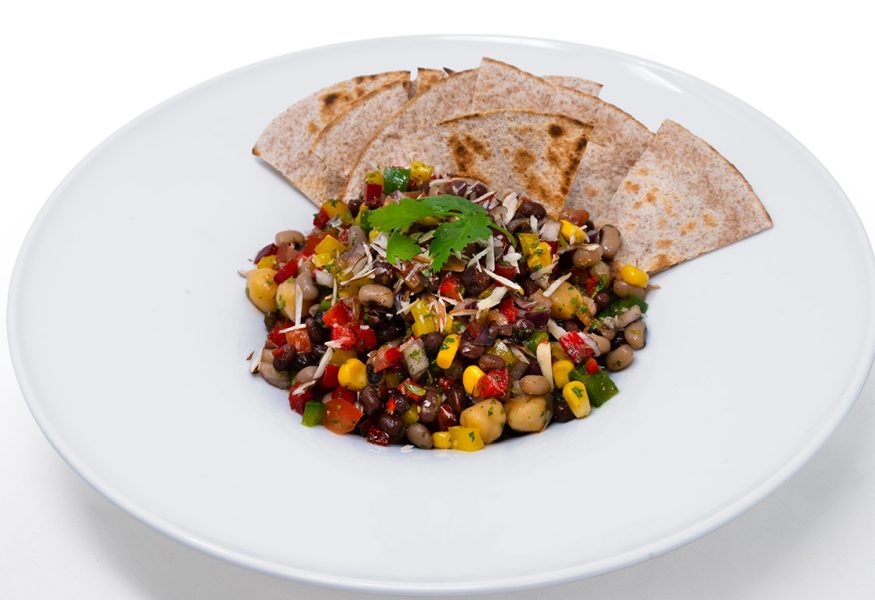
Texas-style caviar with whole wheat tortillas
Preparation time: Less than 30 Minuti
Nutritional information: 624 kcal / per serving
Course: Appetizer
Geographic Area: U.S.A.
Enviromental Impact: Low (0.35kg CO2 eq)
Recipe in partnership with:

This dish gives us a taste of the spicy heat of Texas cuisine, with a perfect combination of legumes and diced vegetables where the tortillas bring out the Tex-Mex soul of the recipe.
Ingredients for 4 portions
- Canned chickpeas 200 g
- Canned eye beans 200 g
- Canned red beans 200 g
- Red cluster tomatoes 160 g
- Assorted peppers 480 g
- Canned corn 80 g
- Red onion 120 g
- Lime peel 4 g
- Fresh coriander 16 g
- Sugar 30 g
- White wine vinegar 80 g
- Olive oil 40 g
- Halls q.b.
- Fresh chili pepper 40 g
- Whole wheat tortillas 400 g
- Roasted peanuts or roasted unpeeled almonds 30 g
Preparation
Wash all vegetables.
Cut the tomatoes into quarters, remove the seeds, then cut them into 1 cm cubes.
Cut the peppers into 1 cm cubes and mix them with the tomatoes.
Add all the beans and chickpeas.
Finely chop the red onion and add it to the mixture.
Add the corn, finely chopped chili, and last the lime peel.
In a small pan, mix the sugar with the vinegar, bring it to a boil and let it cool to room temperature.
Emulsify the extra virgin olive oil with the sweet and sour sauce and season the caviar with this mixture.
Finally, add salt and chopped fresh cilantro.
Toast the tortillas and cut them into triangles.
Serve the caviar sprinkled with peanuts or almonds and with a toasted tortilla next to it.
Enviromental Impact

Low
Details
Per serving:
0.35kg CO2 equivalent
Carbon footprint
To limit our impact on the environment, we advise you to remain within 1 kg CO2-equivalent per meal, including all the courses you eat. Bear in mind that plant-based dishes are more likely to have a low environmental impact.
Even though some of our suggestions exceed the recommended 1 kg CO2-equivalent per meal, that doesn't mean you should never make them; it's the overall balance that counts. Regularly eating a healthy and eco-friendly diet in the long term offsets even the dishes with the most impact, as long as you don't make them too often.