
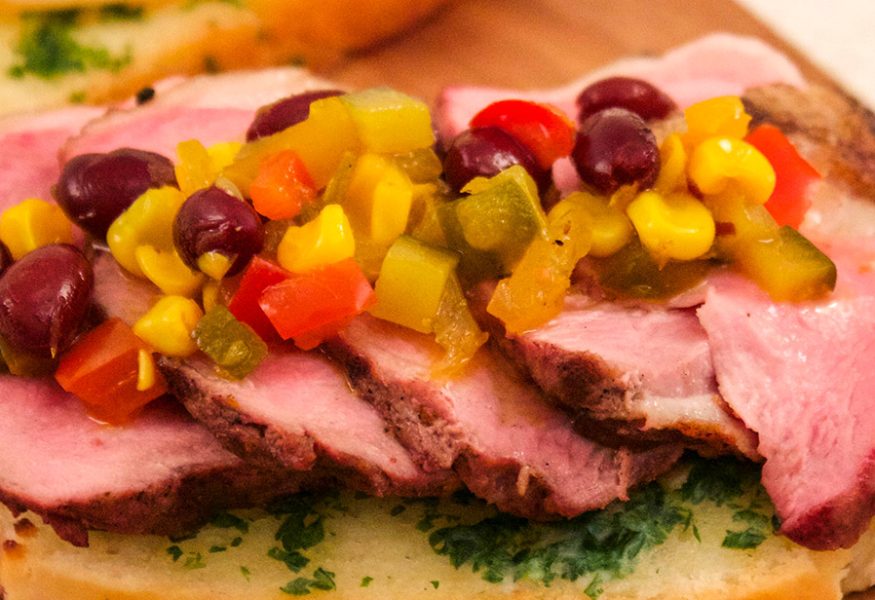
DUCK BREAST SANDWICH WITH CARAMELIZED ONIONS AND “THREE SISTERS” RELISH
Preparation time: Above 60 Minuti
Nutritional information: 440 kcal / per serving
Course: Second course
Geographic Area: Canada
Enviromental Impact: Moderate (0.65kg CO2 eq)
First Nations and Native Americans used to roast whole birds over a fire. Duck hunting is also popular with Canada’s indigenous hunters. The Haudenosaunee traditionally grew corn, beans and squash (the “three sisters”), their staple foods, close together. The corn stalks served as natural poles on which the bean plants could climb. The beans performed a fertilizing action and strengthened the corn to better withstand the winds. The gourd kept weeds away and retained soil moisture. Even today, horticulturists believe that this combination of plants is viable and sustainable.
Ingredients for 4 portions
- Duck breasts 2 (about 225 g each)
- Arugula or baby spinach leaves 200 g
- Slices of whole wheat sandwich bread 8
- Orange peel q.b.
- Kosher or sea salt q.b.
- Ground black pepper q.b.
- Pure olive oil 45 ml
- Chervil (or tarragon), chopped q.b.
- Chives, chopped q.b.
- Onion, sliced 115 g
- Garlic, sliced 6 g
- Sweet corncob (with foil), grilled 1/2
- Jalapeño pepper, with seeds, diced q.b.
- Yellow onion, diced 60 g
- Ground turmeric q.b.
- Zucchini, diced 85 g
- Fresh horseradish, grated 7 g
- Red peppers, diced 30 g
- White vinegar 150 ml
- Ground nutmeg At will
- Caster sugar 125 g
- Green peppers, diced 20 g
- Canned black beans, drained and rinsed 90 g
Preparation
For sandwiches:
With a sharp knife, cut into the skin of the duck breasts by making a couple of cuts first horizontal and then vertical about 1.5 cm deep, being careful not to cut into the meat.
Let the duck breasts marinate for 30-60 minutes in an inert material container (glass, stainless steel or ceramic) with the orange peel, salt, pepper and 15 ml of oil.
Pour 15 ml of oil into a small bowl and add the chervil and chives. Set it aside.
Preheat the oven to 205 degrees F.
In a small saucepan, heat the remaining olive oil and cook the onion and garlic over low heat for about 8 to 10 minutes, stirring frequently, until caramelized. Set them aside.
Arrange the duck breasts skin-side down in a cold cast-iron skillet. Turn the stove on medium heat and let the meat brown, without turning it, for about 3 minutes. Increase the heat to medium-high and continue cooking, again without turning the meat, for another 3 minutes. Then turn the breasts over (skin side up), transfer the pan to the oven and bake them for 10-12 minutes.
Remove the breasts from the pan and set them aside on a cutting board, covering them without sealing with aluminum foil to keep them warm.
Drain the excess oil and heat the cast-iron skillet on the stove. Lightly toast the bread slices in the hot skillet until golden brown, then brush them with the oil and herb mixture.
Trim the fat from the duck breasts and slice them diagonally, then arrange them on the bread slices and top each sandwich with 1⁄4
of the arugula, garlic and onion and 1⁄4 of the relish (recipe follows).
For relish:
Turn the grill on high heat to warm it well, then reduce the heat to medium-high (160° C). Roast the cob inside its foil for 15 minutes. Let it cool. Remove the husk and silk covering the corn kernels. Helping yourself with a knife, shell the kernels from the cob.
Put the corn, onion, zucchini, peppers, and salt in a bowl and mix well. Cover and let stand for 2 hours. Drain the vegetable mix, rinse and let it drain.
In a large pot, combine the black beans, sugar, vinegar, nutmeg, turmeric, horseradish, and jalapeño pepper with the vegetable mix. Bring to a simmer and let simmer for 30 to 40 minutes, stirring occasionally but not allowing all the liquid to evaporate.
Serve the relish freshly made or prepare it in advance and store it in the refrigerator. Consume it within 5 days.
Enviromental Impact

Moderate
Details
Per serving:
0.65kg CO2 equivalent
Carbon footprint
To limit our impact on the environment, we advise you to remain within 1 kg CO2-equivalent per meal, including all the courses you eat. Bear in mind that plant-based dishes are more likely to have a low environmental impact.
Even though some of our suggestions exceed the recommended 1 kg CO2-equivalent per meal, that doesn't mean you should never make them; it's the overall balance that counts. Regularly eating a healthy and eco-friendly diet in the long term offsets even the dishes with the most impact, as long as you don't make them too often.